



Table of Contents
What is a continuous casting machine and its function?
2025-08-02
Continuous Casting Machine (CCM) is a revolutionary equipment in modern metallurgical industry, which completely changes the inefficient production mode of traditional casting process. As a key link between melting and rolling processes, continuous casting machines not only significantly improve production efficiency, but also play an irreplaceable role in improving product quality and reducing energy consumption. This article will comprehensively introduce the working principle, types, core functions, and future development trends of continuous casting machines.
1. Working principle of continuous casting machine
(1) Basic process flow
The workflow of a continuous casting machine mainly includes the following steps:
Molten metal injection: High temperature liquid metal flows out of the furnace and enters the mold through the Tundish.
Initial solidification: In the crystallizer, the metal surface rapidly cools to form a solid shell.
Secondary cooling: After the casting billet is pulled out of the crystallizer, it enters the secondary cooling zone and is cooled by spraying water or mist to completely solidify the internal metal.
Cutting and collection: Fully solidified castings are cut to the required length by a cutting device and transported to subsequent rolling or storage areas.
(2) Key components and functions
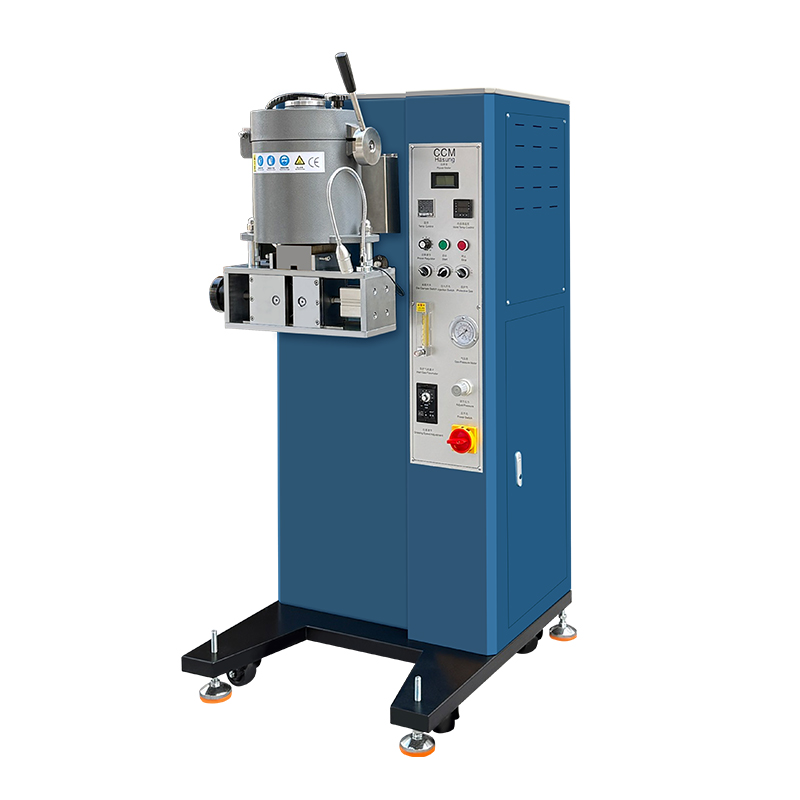
Mold: responsible for the initial solidification of metals, affecting the surface quality of castings.
Withdrawal Unit: Control the pulling speed of the casting billet to ensure continuous production.
Secondary Cooling System: Accelerates internal solidification of castings to prevent defects such as cracks.
Cutting Device: Cut continuous castings into the required length.

2. Types of continuous casting machines
(1) Classified by the shape of the casting billet
Slab caster: produces slabs with a large aspect ratio, mainly used for rolling plates.
Billet Caster: produces square or rectangular billets, suitable for bar and wire production.
Bloom Caster: produces round castings for seamless steel pipes, large forgings, etc.
(2) Classified by structure
Vertical Caster: The equipment is vertically arranged and suitable for high-quality billet production.
Curved Mold Caster: It uses a curved crystallizer to save space and is currently the mainstream model.
Horizontal Caster: mainly used for continuous casting of non-ferrous metals such as copper and aluminum.
3. The core function of continuous casting machine
(1) Key equipment for improving production efficiency
Realize continuous forming from liquid metal to solid castings, eliminating the intermittent waiting time of traditional mold casting
The production rhythm is perfectly matched with upstream melting and downstream rolling, forming an efficient continuous production line
The single stream production capacity can reach over 200 tons per hour, significantly improving overall output
(2) The core link to ensure product quality
The precisely controlled cooling process ensures uniform microstructure of the cast billet, significantly reducing defects such as segregation and shrinkage porosity
High degree of automation, reducing the impact of human factors on quality
Excellent surface quality, reducing subsequent processing costs and scrap rates
(3) Important guarantee for energy conservation and consumption reduction
The metal yield can reach 96-98%, which is 10-15% higher than the mold casting process
High thermal energy utilization efficiency, reducing energy consumption for repeated heating
The cooling water circulation system significantly reduces water resource consumption
(4) The foundation for achieving production automation
Provide key interfaces for intelligent production throughout the entire process
Real time data collection provides a basis for process optimization
Integrate with upstream and downstream equipment to build a digital factory
4. Advantages of continuous casting machines
(1) Revolutionary improvement in production efficiency
Continuous operation mode increases production capacity by 3-5 times
Equipment utilization rate of over 85%
(2) Significant improvement in product quality
Internal organization is denser and more uniform
Higher dimensional accuracy and more precise tolerance control
(3) Significant reduction in production costs
Reduce manpower demand by more than 50%
Reduce energy consumption by 20-30%
The direct economic benefits brought by the increase in yield rate
5. Development trend of continuous casting technology
(1) Intelligence and automation
Using AI algorithms to optimize process parameters and improve the quality of castings.
Remote monitoring and fault prediction to reduce downtime.
(2) New materials and new processes
Develop high-performance copper alloys for crystallizers to extend their service life.
Electromagnetic stirring technology (EMS) improves the internal structure of castings.
(3) Green Casting Technology
Waste heat recovery and utilization to reduce energy consumption.
Reduce cooling water consumption and improve environmental performance.
conclusion
As the core equipment of modern metallurgical industry, continuous casting machine plays an irreplaceable key role in improving production efficiency, ensuring product quality, and reducing production costs. Its technological progress directly drives the development of the entire metallurgical industry. In the future, with the deepening application of intelligent and green technologies, continuous casting machines will continue to lead the innovation and transformation of metallurgical manufacturing processes.
ReviewsNumber of comments: {{ page.total }}
I want to comment?
{{item.nickname ? (item.nickname.slice(0, 2) + '*****') : item.source === 1 ? 'mall buyer' : '--'}}
{{item.comment_time}}
Review in the {{item.country}}
Reviews
Merchant
{{replyItem.nickname ? (replyItem.nickname.slice(0, 2) + '*****') : replyItem.source === 1 ? 'mall buyer' : '--'}}
{{replyItem.parent_nickname ? (replyItem.parent_nickname.slice(0, 2) + '*****') : '--'}}
{{replyItem.is_merchant_reply === 1 ? replyItem.reply_time : replyItem.comment_time}}
Review in the {{replyItem.country}}
Reviews

No customer reviews
recommended for you
Get in touch with us
Hasung is a leading provider in the jewellery casting machine and gold casting machine which for the precious metals and new materials industry.
CONTACT US
Contact Person: Jack Heung
Tel: +86 17898439424
E-mail: sales@hasungmachinery.com
WhatsApp: 0086 17898439424
Address: No.11, Jinyuan 1st Road, Heao Community, Yuanshan Street, Longgang District, ShenZhen, China 518115
Tel: +86 17898439424
E-mail: sales@hasungmachinery.com
WhatsApp: 0086 17898439424
Address: No.11, Jinyuan 1st Road, Heao Community, Yuanshan Street, Longgang District, ShenZhen, China 518115
Copyright © 2026 Shenzhen Hasung Precious Metals Equipment Technology Co., Ltd | Sitemap | Privacy Policy